
When people hear SEO, they often think about keywords, backlinks, and Google rankings.
But there is something much closer to home that you should focus on first — your own website.
That is where On-Page SEO comes in.
What Is On-Page SEO?
On-Page SEO is basically everything you do on your website and on your individual pages to help search engines understand your content better.
The goal is pretty simple:
Create useful content, structure it properly, and make it easy for both people and search engines to understand.
You cannot control Google’s algorithm.
But you can control your content, your website structure, and the experience you give your visitors.
That’s what makes On-Page SEO so important.
The Important Parts of On-Page SEO
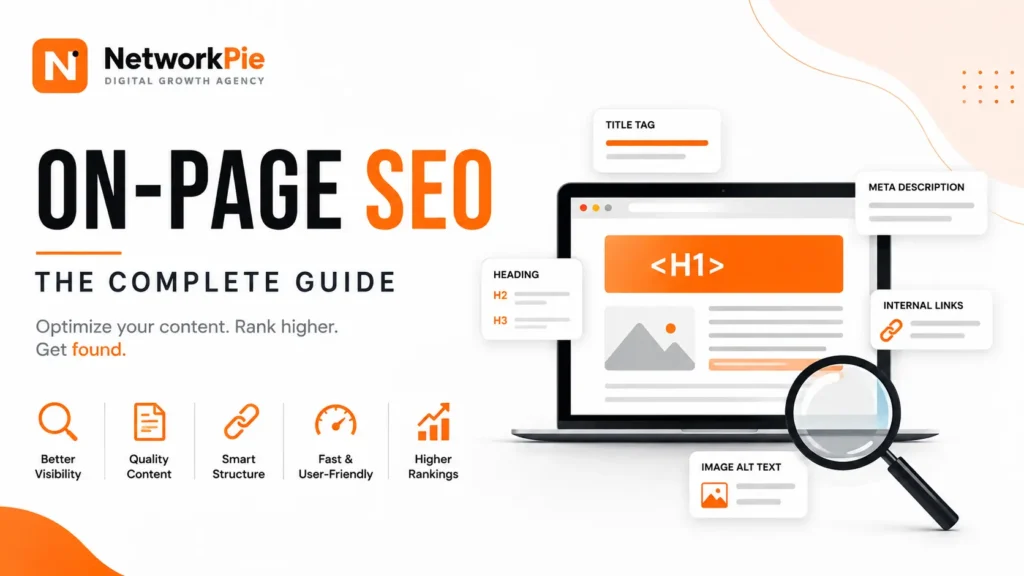
1. Title Tag
Your title is one of the first things people see when your page appears in search results.
It should clearly tell people what the page is about.
For example:
Bad:SEO Tips
Better:10 Simple SEO Tips for Beginners
Keep it clear, relevant, and interesting.
2. Meta Description
The meta description is the small piece of text that usually appears below your title in search results.
It doesn’t directly decide your ranking, but a good description can make someone more likely to click on your page.
Think of it as a small invitation to read your article.
3. URL Structure
Keep your URLs simple.
Instead of:
website.com/page?id=2837&category=seo
Use something like:
website.com/on-page-seo
A clean URL is easier for people to understand and easier for search engines to interpret.
4. Headings
Don’t write your entire article as one big block of text.
Use headings like:
H1 → Main topic
H2 → Main sections
H3 → Smaller sections
Headings give your content structure and make it easier for people to scan.
And yes, people scan articles more than they read every single word.
5. Content Quality
This is probably the most important part.
Don’t create content just because you want to rank.
Create content because you actually have something useful to say.
Your content should answer the question, solve the problem, explain the topic, or help the reader make a decision.
Write for people first.
Google is getting better at understanding whether content is actually useful.
6. Keywords
Keywords still matter.
But stuffing the same keyword into every sentence isn’t SEO.
If your article is about On-Page SEO, naturally use related terms where they make sense.
Your primary keyword can appear in places such as:
- Title
- Main heading
- Introduction
- Subheadings
- URL
- Image alt text
- Body content
But don’t force it.
If a sentence sounds weird because you are trying to insert a keyword, remove the keyword.
Natural writing is better than keyword stuffing.
7. Internal Linking
You don’t have to let every page on your website live alone.
Link relevant pages to each other.
For example, if you’re writing about On-Page SEO, you can link to your articles about:
- Keywords
- Technical SEO
- Off-Page SEO
- Search Intent
This helps readers discover more content and also helps search engines understand how your website is connected.
8. Images and Alt Text
Images can make your content easier to understand and more interesting to read.
But don’t just upload an image and forget about it.
Give your images meaningful file names and use descriptive alt text where appropriate.
For example:
seo.jpg
is less useful than:
on-page-seo-guide.jpg
Alt text also helps make your website more accessible.
9. Readability
Nobody likes reading a giant wall of text.
Use:
- Short paragraphs
- Simple language
- Bullet points
- Clear headings
- Enough spacing
Your goal isn’t to make your article look complicated.
Your goal is to make it easy to consume.
10. Mobile-Friendliness
A huge percentage of people browse the internet from their phones.
So your website needs to work properly on smaller screens.
Text should be readable.
Buttons should be easy to tap.
Images shouldn’t break the layout.
And users shouldn’t have to zoom in just to read your content.
11. Page Speed
Nobody likes a slow website.
If your page takes forever to load, people may simply leave.
Optimize your images, use reliable hosting, reduce unnecessary scripts, and keep your website clean.
A faster website generally means a better experience for your visitors.
On-Page SEO Best Practices
There are no magic tricks here.
Just follow some basic principles:
- Write for humans first.
- Understand what people are actually searching for.
- Use keywords naturally.
- Don’t stuff keywords everywhere.
- Keep your content useful and updated.
- Use internal links where they make sense.
- Make your pages easy to read.
- Make your website mobile-friendly.
- Keep your pages fast.
- Give every page a clear purpose.
The Biggest Mistake People Make
The biggest mistake is thinking that On-Page SEO is about tricking Google.
It isn’t.
You don’t need to repeat a keyword 50 times.
You don’t need to write awkward sentences.
You don’t need to make your article longer just because someone told you that long articles rank better.
Instead, ask yourself:
“If someone lands on this page, will they actually find what they’re looking for?”
If the answer is yes, you’re already thinking in the right direction.
Final Thoughts
On-Page SEO is not complicated.
It is mostly about clarity, relevance, structure, and usefulness.
Make your content easy to understand.
Make your website easy to navigate.
Answer the question people came to your website for.
Then give search engines enough information to understand what your page is about.
That’s it.
Don’t write for Google. Write for people — and optimize for Google along the way.
That’s the real On-Page SEO.